Workplace Innovation in Practice: From Ambition to Everyday Capability

Lessons from an international EUWIN workshop on leadership, technology, trust and the difficult work of scaling change.
BRUSSELS: 1st October 2026

The European Workplace Innovation Network
EUWIN Bulletin November 2026
Workplace innovation has moved from the margins of European debate to its centre, not least in the current Industry 5.0 focus on human centricity. Yet recognition is not the same as implementation. That tension ran through an international EUWIN workshop bringing together company leaders, practitioners and researchers from across Europe and beyond. Their message was both optimistic and demanding: better work can produce better organisations, but it cannot be delivered by technology, policy or managerial instruction alone. It depends on the patient construction of workplaces in which people have the autonomy, capability, information and trust to solve problems together.
A deceptively simple proposition
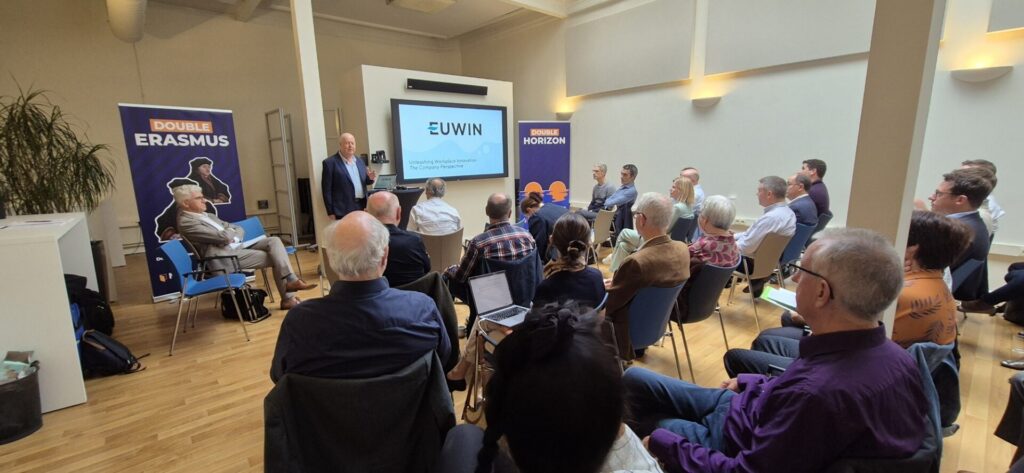
The workshop opened with a keynote presentation by Steven Dhondt (TNO/KUL) and a deliberately provocative proposition: workplace innovation is valuable, but hard; scaling it is harder still. The concept is now increasingly present in policy discussions, especially in relation to Industry 5.0 and its emphasis on human-centred, resilient and sustainable industry. However, Steven challenged the assumption that higher productivity can be secured primarily through investment, deregulation or the acquisition of new technologies. Organisations themselves have responsibilities. They must examine how work is designed, how decisions are made, how knowledge moves and how the gains from innovation are shared. This shifts the debate from what organisations buy to what they are capable of doing with what they buy. A new machine, digital platform or artificial-intelligence system may expand technical possibilities, but value is realised only when people can interpret information, question routines, coordinate across boundaries and adapt the technology to real conditions. Workplace innovation is therefore not a programme running alongside the business; it is a way of increasing the organisation’s capacity to convert knowledge and investment into sustained performance.
That point matters because apparently similar organisations often produce persistently different outcomes. They may use comparable technologies, employ the same consultants and operate in the same markets, yet differ sharply in productivity, quality, adaptability and employee experience. The workshop linked these differences to the strength of the relationships inside the organisation: the informal and formal understandings through which managers, employees, specialists and representatives exchange trust, discretion, effort and support. Such relationships cannot be installed as a standard package. They are built through repeated experience—people speak up, someone listens, action follows, and confidence grows.
Four practical barriers emerged. The first is perception: organisations may already be doing parts of workplace innovation without possessing a language that helps them see the whole. The second is motivation: leaders may recognise the case for change but lack incentives, permission or courage to begin. The third is inspiration: people need credible examples that make a different way of working imaginable. The fourth is implementation: even a compelling idea can fail when it meets rigid structures, weak communication, competing priorities or a culture of control. These barriers explain why workplace innovation is not a recipe based on ten universal steps. It is a process of learning, negotiation and adaptation. They also suggest that dissemination must do more than broadcast success stories. Organisations need opportunities to diagnose their own starting point, compare experience with peers, test ideas in manageable settings and build internal coalitions capable of carrying change forward. Inspiration opens the door, but diagnostic insight, practical support and persistence determine whether anyone walks through it.
Four organisational journeys
Public service: dramatic gains, fragile foundations
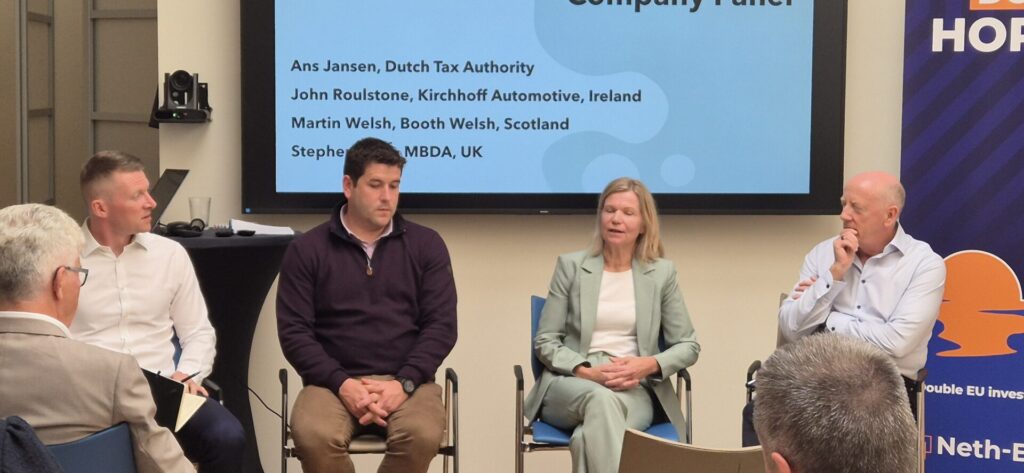
Experience from the Dutch Tax Authority presented by Ans Jansen showed both the power and fragility of local transformation. A previously fragmented five-stage process was redesigned around multifunctional teams, a single workflow and direct handovers between colleagues as part of a pilot programme. Within months, one location rose from the middle of the performance ranking to the top, while another improved substantially. The strongest site achieved roughly three times the production of the weakest and quality above 95 per cent. Yet the wider organisation did not adopt the model. Functional divisions, end-stage control and a control-oriented culture remained intact. When the pilot programme ended, the conversation and the mechanism for spreading learning ended with it. The lesson was stark: local success does not scale itself. Evidence alone is rarely enough to overcome established authority, professional boundaries and familiar control systems. Scaling requires an explicit transfer process: time to observe the new model, forums in which sceptics can examine the evidence, senior sponsorship, and permission for receiving teams to adapt the principles rather than copy the original design mechanically. Without those bridges, even exceptional performance can remain an isolated episode.
Manufacturing: from supervision to facilitation
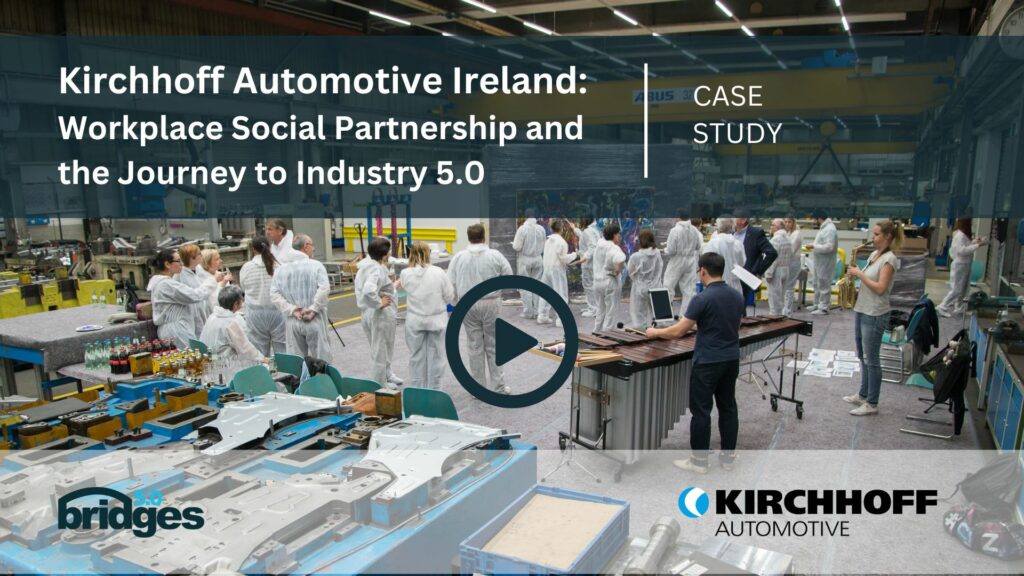
John Roulstone, Operations Manager at Kirchhoff Automotive Ireland, offered a contrasting story of sustained change. Emerging from the 2008 crisis, management and trade union representatives recognised that the business would have to change to survive. An imported lean production system, originating in Japan and introduced through a German consultancy, failed to take root in the Irish plant. Progress began when employees were brought into the design of the system itself, facilitated by support from a specialist team based in SIPTU, Ireland’s largest trade union. Over time, the plant removed management and supervisory layers, created small self-managing teams and used shared production data to support everyday decisions. Managers increasingly became facilitators rather than controllers. The commercial implications are significant. The plant experienced sustained growth whilst limiting the increase in headcount through automation, semi-automation and smarter organisation. Crucially, new equipment is no longer designed at a distance and handed over to operators as a finished solution. End users participate early, including in the development and testing of machinery, because they will ultimately have to make it work under real production conditions. This is a practical expression of human-centred innovation: technical expertise and operational knowledge are combined before decisions become expensive to reverse. Early participation also changes the quality of implementation. Operators can identify maintenance risks, awkward interfaces, likely sources of downtime and training needs that may be invisible in a remote design office. Their involvement reduces the gap between technical specification and operational reality, while creating ownership long before the equipment arrives on the shop floor.
Employee ownership: culture made tangible
Martin Welsh, CEO of Scottish engineering services company Booth Welsh traced a 37-year journey from family ownership, through a management buyout and international ownership, to employee ownership. During its years inside a global group, the business remained successful but gradually lost connection with its distinctive purpose and culture. Distant shareholder expectations began to dominate. A workplace innovation programme launched in 2017 helped rebuild team engagement, with active workforce involvement in shaping business strategy and the introduction of more participative forms of work organisation.
However, a crisis arrived when the parent company entered administration in 2022. A strengthened workplace culture ensured that employees and clients stayed loyal, whilst twenty long-serving managers joined a rescue buyout, and the company subsequently became fully employee-owned. Here, the shift from shareholder value to stakeholder value is not an abstract principle but a governance choice. Ownership has encouraged teams to think about the future of the whole business, not only their immediate tasks. Yet employee ownership is not a final destination. Succession planning, leadership renewal and knowledge transfer remain pressing challenges, particularly in a company with long service and several generations working together. The case demonstrated that resilient culture can protect a firm through crisis, while also reminding participants that culture must be continually renewed.
Innovation agents: building capability from within
MBDA, a large, engineering-intensive European company in the defence sector has a clear objective: to train one per cent of the workforce as “innovation agents”. Stephen Buck, Innovation Training Lead, explained that innovation agents bring practical innovation methods into their own teams and functions, beginning with a real problem from their workplace. The approach recognises that innovation cannot be confined to research and development or treated as the preserve of technical specialists. Administrative processes, team relationships, data use and work organisation also need innovation. The challenge is what happens after training. People return enthusiastic, but delivery pressures quickly reclaim their attention. Psychological safety is also uneven: employees may hesitate to challenge established procedures or admit that an experiment failed. National boundaries, security requirements and organisational silos can restrict sharing even within one company. The innovation-agent model therefore depends on more than individual skills. It needs protected time, visible sponsorship, peer support and routes through which local learning can influence wider decisions. It also needs a portfolio view of experimentation. Not every initiative will produce an immediate financial return, but patterns across many small experiments can reveal recurring obstacles, transferable methods and emerging strategic opportunities. Capturing those lessons turns isolated acts of ingenuity into organisational memory.
The recurring fault lines
Responding to the cases, an expert panel comprising Peter Oeij (TNO), Frank Pot (EUWIN) and Edwin Van Vlierberghe (Edel Advies) identified five critical tensions. Firstly, technology can enable innovation but can also become a substitute for organisational change. Buying licences, machines or platforms does not create the knowledge, dialogue or discretion needed to use them well. Artificial intelligence sharpens this issue: the critical question is not merely which tools to adopt, but how workers participate in deciding their purpose, limits and distribution of benefits.
Secondly, participation must reach beyond suggestions about immediate tasks. Employees need a voice in technology choices, workflow design and strategic questions about the organisation’s direction.
Thirdly, autonomy must be matched by capability and accountability. Empowerment without information, training or timely support is abandonment; control without autonomy suppresses learning.
Fourthly, the effects of workplace innovation often take time to appear and can be hard to connect to conventional financial indicators. Organisations therefore need measures that link employee experience and organisational capability with quality, productivity, retention, innovation and resilience. Fifthly, continuity is vulnerable when change depends on a small number of champions. Leaders leave, projects close and priorities shift. Sustainable change requires structures that carry the practice beyond individual enthusiasm. These tensions are interconnected. Weak participation undermines technology adoption; poor measures make experimentation difficult to defend; and dependence on charismatic champions prevents new practices from becoming routine. The task is therefore systemic: aligning work design, leadership behaviour, skills, information flows and governance so that each reinforces the others.
Leadership, structure and culture
Much of the discussion returned to leadership, but not leadership as status. Workplace innovation calls for leaders who articulate purpose, create room for judgement and respond when teams escalate problems they cannot solve alone. Trust disappears quickly when people are invited to take responsibility but receive no support. Leaders must also be willing to question themselves. Past success can become a trap when routines that once worked are defended against a changing context. At the same time, several contributors warned against treating culture as independent of organisational design. Strategy shapes structure; structure can enable or disable autonomy; and repeated experience within that structure forms culture. Self-managing teams, cross-functional workflows, worker representation, escalation routines, shared objectives and employee ownership are not simply expressions of trust—they are mechanisms that make trust actionable. Culture cannot compensate indefinitely for a structure that concentrates information and authority at the top.
From isolated examples to an ecosystem
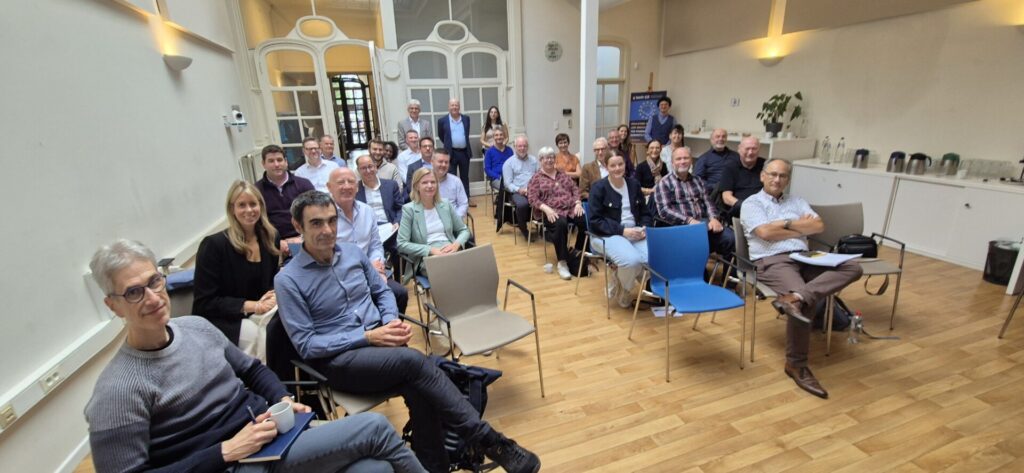
The workshop repeatedly confronted the problem of dissemination. Europe has decades of programmes, experiments and evaluations, yet lessons are often rediscovered rather than accumulated. Companies may dismiss examples by saying, “we are different”, while successful sites struggle to transfer their practices even to sister plants. A more effective ecosystem would connect companies, trade unions, universities, consultants, regional bodies and policymakers around shared learning rather than one-way promotion. Several practical routes were identified: structured visits in which participants return with specific questions; learning factories where organisations can test technology safely; knowledge-transfer partnerships with universities; regional manufacturing networks; open-innovation teams; and communities of practice that continue between physical events. Public policy also has leverage. Technology funding can be made conditional on attention to job quality, participation and workplace innovation, ensuring that public investment strengthens organisational capability rather than merely subsidising equipment.
A practical agenda
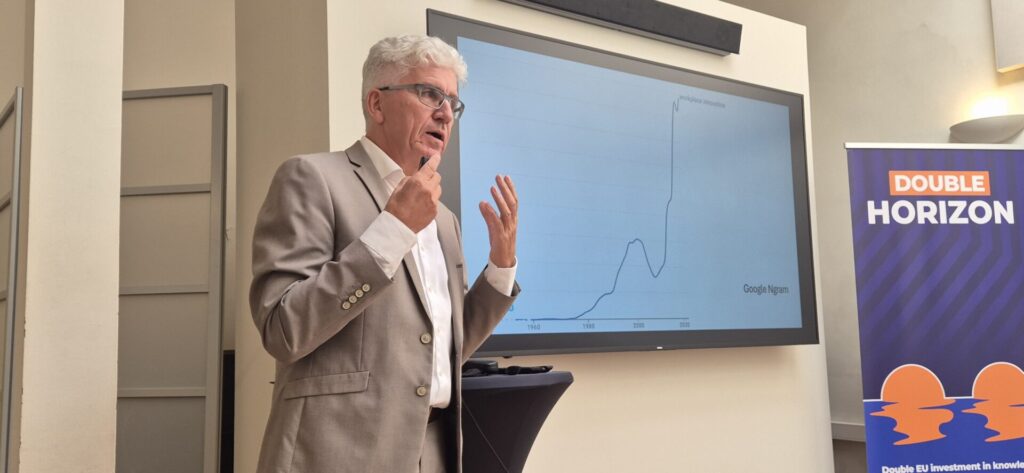
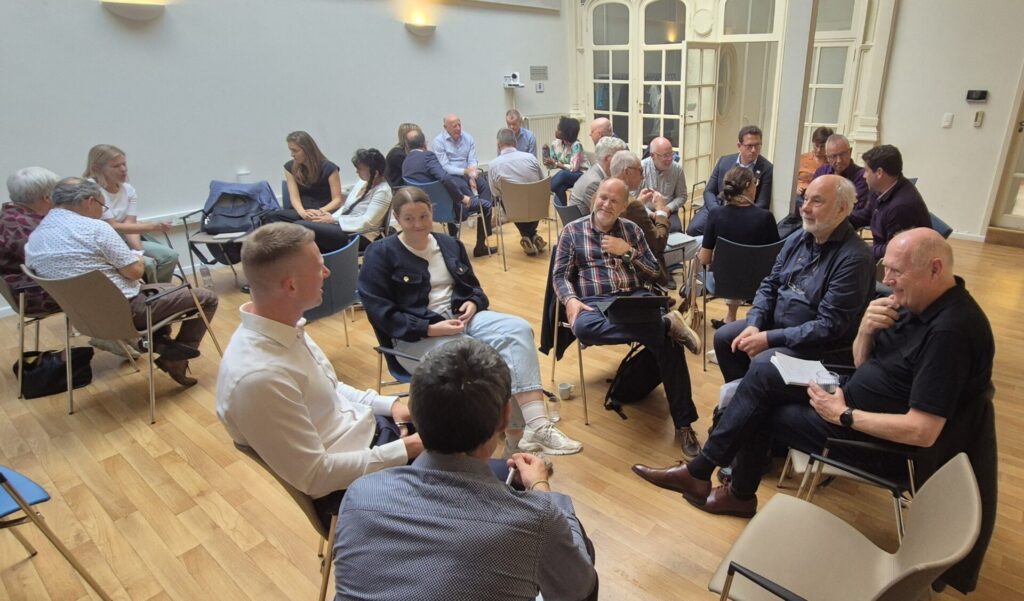
The closing group discussions distilled the day into a practical agenda. Organisations should begin by creating clarity about purpose and by translating strategic objectives into language meaningful at team level. They should give employees genuine opportunities to shape solutions, not merely consult them after decisions have been made. Teams need autonomy close to the work, clear accountability, access to data and rapid support when problems exceed their authority. Leaders must protect time for reflection and experimentation, respond visibly to employee voice and treat well-designed failure as a source of learning. A practical starting sequence might be modest but disciplined: identify one persistent operational problem; convene the people who experience it from different perspectives; agree what success would look like; test a change on a small scale; review both performance and employee experience; and decide what to adapt, stop or spread. The sequence matters less than the habits it creates—shared diagnosis, evidence-based experimentation and visible follow-through.
They should also build innovation into work itself through multifunctional collaboration, job breadth, peer learning and regular spaces to step back from delivery. Measurement must combine hard outcomes—quality, throughput, reliability and financial performance—with leading indicators such as the speed of problem resolution, participation in improvement, knowledge sharing and employee experience. Finally, every initiative needs a plan for continuity: how practices will survive a change of manager, the closure of a project or the departure of a champion. The central conclusion was not that one model should be copied. It was that organisations need the capability to keep redesigning themselves with their people. Workplace innovation succeeds when technical, organisational and behavioural change reinforce one another; when leaders exchange control for clarity and support; when employees have both a voice and the means to act; and when learning travels across boundaries. In an era of rapid technological change, demographic transition and geopolitical uncertainty, that capability is not a desirable extra. It is a condition of resilience. The workshop’s deeper challenge is therefore to move beyond episodic projects and make participative renewal an ordinary organisational competence. That means asking, repeatedly, not only whether a new process works, but who helped design it, what people learned, where authority sits, how benefits are shared and whether the organisation is now better equipped to face the next disruption. The organisations most likely to thrive will not be those that predict every change correctly. They will be those that have learned how to respond collectively when prediction fails.
An offer
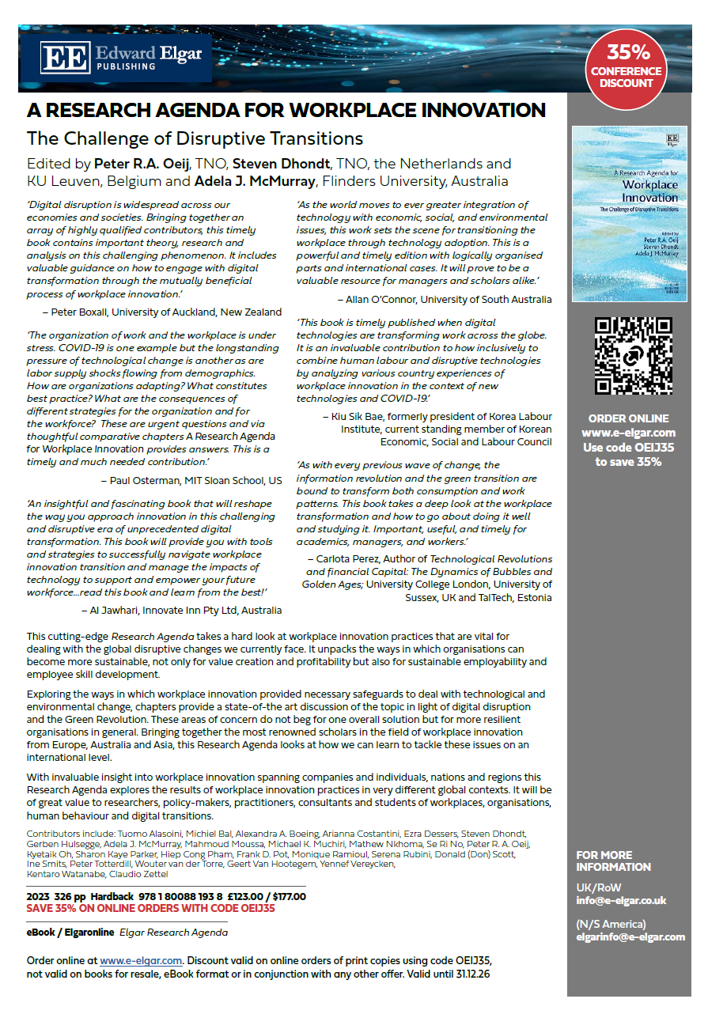
For the occasion, Edward Elgar Publishing are offering a 35% discount for their 2023 publication ‘A Research Agenda for Workplace Innovation’ when ordered online at www.e-elgar.com. The discount is valid on online orders of print copies using code OEIJ35 (Not valid on books for resale, eBook format or in conjunction with any other offer. Valid until 31.12.26).








Responses